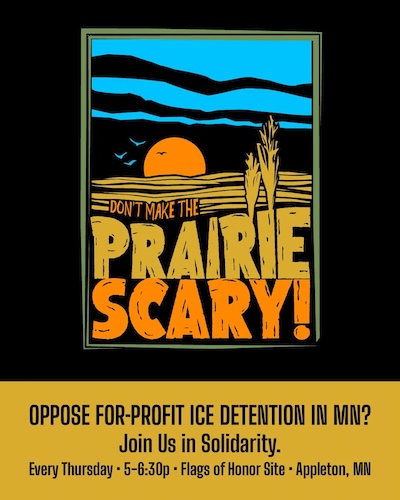
Organizers local to the Appleton, MN area also be talking with attendees at the Swift County Fair. If you're interested in connecting more, email misty@curemn.org.
Homeland Security buys former prison in west-central Minnesota for $500 million
Late breaking news
MPR
"A day after it was announced that a former private prison in west-central Minnesota will be used to house ICE detainees, the company running the facility has announced the former prison’s sale to the U.S. government for half a billion dollars.
"The private prison company CoreCivic said in an investors statement that they've sold the 1,600 bed Prairie Correctional Facility in Appleton, Minn., to the U.S. through the Department of Homeland Security for $495.6 million. CoreCivic will still manage the facility, which is expected to start receiving ICE detainees this fall and be up to full capacity by mid-2017."
ICE, CoreCivic to open Appleton immigrant detention center this year
It will be the first detention center of its kind in Minnesota
Minnesota Reformer
"Immigration and Customs Enforcement will pay private prison company CoreCivic more than half a billion dollars to reopen a defunct 1,600-bed prison in rural western Minnesota as an immigrant detention center.
"CoreCivic runs some of the country’s largest and most infamous immigrant detention centers, including the Dilley Immigration Processing Center in Texas... Disease outbreaks, lack of medical care, inedible food and lack of outside time are common complaints."
AFSCME Council 5 Strongly Condemns ICE–CoreCivic Contract to Reopen Appleton Private Prison
"AFSCME Council 5 strongly condemns the decision by ICE to contract with CoreCivic to reopen the Prairie Correctional Facility in Appleton, MN as a for-profit, private immigrant detention center. This decision is morally wrong, dangerous, and more costly for communities across Minnesota, and is fundamentally at odds with the values of dignity, justice, and respect that we hold dear as Minnesotans.
"No corporation should generate revenue and profit from imprisoning human beings, separating families, and expanding a for-profit detention industry that treats human beings and workers as sources of profit for shareholders. When a corporation’s revenue depends on keeping more people locked behind bars for longer periods of time in dangerous conditions and having poorly trained and equipped staff on site, safety and human dignity will always come second to the company’s bottom line."
First Private ICE Detention Facility in the State Sets a Dangerous Precedent
The Immigrant Law Center of Minnesota issues a statement
"The Immigrant Law Center of Minnesota (ILCM) is appalled at the U.S. Immigration and Customs Enforcement (ICE) detention facility set to open in Appleton, Minnesota. At 1,600 beds, the CoreCivic facility would be the first private ICE detention facility in the state and among the largest carceral facilities in Minnesota.
"It’s a staggering increase over the immigration detention capacity currently contracted to county jails. ILCM warns that the facility’s scale and its remoteness threaten the ability of detained people to access legal counsel. Across the country, immigrants in detention centers are denied healthcare, living in overcrowded spaces, and treated barbarically.
"ILCM denounces privatized detention as a revenue stream. A system that pays a private company per person, per day creates an incentive to take people away and detain them for longer. As Operation Metro Surge and other actions have shown, incentivizing detentions incentivizes violence against communities, violations of civil rights and civil liberties, and further dehumanization of immigrants and refugees."
After the siege on our state by out-of-control federal agents who flagrantly ignored the law, it is an insult to our communities to open a for-profit concentration camp in our state. We oppose any concentration camp in Minnesota, or anywhere else
Indivisible Twin Cities
"Per the CoreCivic news release, '... we expect this facility to generate total annual revenue of approximately $75 million.'
"That is $75 million of OUR tax dollars. We will be paying CoreCivic to house human beings for no other crime than the color of their skin and that they came from another country for a better life in the United States.
"And as we saw during the occupation of the Twin Cities last winter, ICE will pick up anyone in their path, non-criminals, people who are here legally and even U.S. citizens. The federal agents of DHS/ICE/CBP do not bother with due process. They just want to meet cruel quotas and will grab and lock up anyone they choose. Anyone ICE snatches could wind up in a place like the Prairie Detention Center in Appleton.
Appleton detention facility could start holding ICE detainees this fall
Hundreds of people swept up by Immigration and Customs Enforcement officers could be detained at a facility in west-central Minnesota
MPR
"Detention centers used by ICE, including the facility in Dilley, Tex. operated by CoreCivic, have become flashpoints for protests against the agency and the Trump administration’s immigration policies.
"It appears the Appleton facility will also draw public demonstrations.
"'AFSCME Council 5 strongly condemns the decision by ICE to contract with CoreCivic to reopen the Prairie Correctional Facility in Appleton as a for-profit immigrant detention center,' said executive director Bart Anderson in a statement. 'This decision is morally wrong, dangerous, and more costly for Minnesota communities, and is fundamentally at odds with the values of dignity, justice, and respect that we hold dear as Minnesotans.'
"The organization, which represents more than 40,000 workers including public sector employees, health care workers and non-profit group employees, posted a notice on Facebook about a series of protests to be held every Thursday in Appleton."
"Minnesotans saw this winter how ICE and its detention network are being used to systematically deprive people of their rights, often without regard to legal status. The Trump administration’s plan for a vast private prison network threatens to extend these harms and erode our democracy.
"A 1,600-bed private ICE detention center would have serious consequences for Appleton, Swift County, and the broader region. Residents have not been given meaningful information to understand what is being proposed, who is making the decisions, or what costs the community may be expected to absorb. Residents haven’t been given adequate opportunity to ask questions or provide their views. We are concerned about the strain this facility could place on local housing, healthcare, emergency response, public safety, transportation, and other city and county resources. Rural communities should not be left to manage or pay for the fallout of federal detention expansion while private prison corporations garner all the benefits for their investors.
"As rural Minnesotans, we care for our immigrant neighbors who are raising families, running businesses, and building lives in the small towns we call home. We recognize that they love these communities like we do. Many of us carry our own family histories of immigration to this place in search of a better life. No one is safer or better off when our government denies people their rights and due process under the law. The prison should not be reopened as a for-profit private ICE detention center."
Long-shuttered Appleton, Minn., prison to reopen for ICE detainees
The 1,600-bed prison is expected to open this fall. Contractors started repairs on the facility last year.
MN Star Tribune (Gift link)
"The privately owned prison in Appleton, Minn., that was shuttered 16 years ago will reopen in the fall to hold detainees for U.S. Immigration and Customs Enforcement.
"Owner and private prison operator CoreCivic announced a five-year deal Tuesday with the U.S. Department of Homeland Security to house up to 1,600 ICE detainees. The reopening will happen in stages, and the prison is expected to be fully operational by next spring.
"CoreCivic is one of the largest government contractors for immigrant detention and recently sold two California detention facilities to DHS for $1.5 billion.
"Lauren-Brooke Eisen, senior director of the Brennan Center’s Justice Program at the NYU School of Law, said federal officials are increasingly reliant on private prison contractors to hold immigrant detainees. The move comes after communities nationwide pushed back against ICE’s attempts to retrofit warehouses as detention facilities.
"State Sen. Ron Latz, DFL- St. Louis Park, chair of the Senate Judiciary and Public Safety Committee, said Minnesota banned the use of private prisons in 2023. He said he’ll explore ways to stop the facility from reopening.
"'The planned use of Appleton Prison as an ICE detention center is an affront to all Minnesotans, who have soundly rejected the barbaric immigration policies and practices of this administration,' Latz said in a statement. 'No one should be detained for profit and a corporation’s bottom line.'
"Under President Trump the number of immigrants in ICE custody has soared from about 40,000 to more than 65,000. Increasingly, these detainees are being held in facilities owned or operated by for-profit prison companies.
"Contracts for immigrant detention provide about 35% of CoreCivic revenue, according to company financials.
"Detention centers across the U.S. have been accused of holding immigrants in unsanitary conditions, serving them spoiled food and providing poor medical care. There have been 55 deaths in immigrant detention since Trump returned to office."
Minnesota banned private prisons. ICE is bringing one back anyway
DOC commissioner: The state cannot stop DHS’ apparent plans to open a privately-run ICE detention center in Appleton, Minn. But we should speak loudly against it.
MN Star Tribune (Gift link)
"The company reported $116.5 million in profit in 2025, nearly 70% higher than the year before. During earnings calls, analysts complained that Immigration and Customs Enforcement (ICE) isn’t detaining people fast enough to maximize returns. This is not a public safety partnership. It is a business that grows more profitable with every person detained.
"DHS is not claiming Minnesota lacks detention capacity. Rather, it wants to make an example of our state again, detaining people from across the country — individuals with no connection to Appleton and who would be separated from legal counsel, family and meaningful oversight.
"As a leader of our state’s correctional facilities, I know what safety and security look like when done well and what the human impact is when it isn’t. Minnesota is once again being forced to absorb the consequences of a reckless and poorly implemented effort that will likely result in more unnecessary deaths, family separations, community outrage and significant local impacts.
"According to reporting by the Guardian, 2025 was the deadliest year for ICE detention in two decades with 32 people dying while in custody. Most people held in these facilities have not been convicted of crimes. They are parents, working people and neighbors awaiting administrative immigration proceedings. Yet congressional investigators and federal inspectors have documented medical neglect, malnourishment, punishment and denial of care, including for pregnant women. Inspectors call these conditions barbaric."
As ICE eyes-up a shuttered private prison in Appleton, Minnesota, locals, faith leaders, scholars, and community organizers are speaking out about the moral and economic repercussions
The Daily Yonder — Keep it Rural
"An empty 1,600-bed private prison has sat idly on land that was once a soybean field in rural Appleton, Minnesota since the prison failed and, as a result, tanked the town’s economy in 2010.
"Now, ICE is seeking to reinhabit the bones of Prairie Correctional Facility (PCF) and use it as a new detention facility, according to a federal contract released on June 4.
"ICE is coordinating the effort with CoreCivic, the same private prison company that oversaw the operation and failure of PCF.
"The extreme volatility of migrant detention makes it 'a particularly treacherous industry to link a community’s financial future to,' Nofil said.
"Opening a 'zombie' immigrant detention facility in Appleton may very well lead it down the same path PCF did, pulling the rug out from under the community without reliable systems in place for long-term economic health.
"It would also bring an industry of highly questionable morality to people’s backyards.
"Gonzalez said she thinks about the people who would be held in the facility: 'It’s moms and dads and sons and daughters and cousins and grandparents and church people… who would be criminalized and warehoused there.'
ICE eyes 1,000-bed detention facilities in foreign countries
The U.S. Department of Homeland Security is looking for private contractors that could help set up "international staging areas" abroad.
The Redoubt
"As part of its drive to ramp up mass deportations, the Trump administration is exploring the possibility of building detention facilities in other nations that could each hold up to 1,000 "illegal aliens," according to documents reviewed by The Redoubt.
"The revelation is included in a posting on a federal government contracting website and indicates that the U.S. Department of Homeland Security is in the early stages of identifying potential partners in the private sector. According to the listing, DHS — specifically its sub-agency, U.S. Immigration and Customs Enforcement — would like to identify contractors that could maintain "a fleet of aircraft utilized to support removal operations for deportations," and to facilitate the removal and incarceration of deported people in facilities abroad.
"In recent weeks, there has been a surge of arrests by federal immigration agents in the United States, with over 10,000 people recently detained in a span of five days. More than 63,000 people are presently in ICE custody. Two-thirds of those detained have never been convicted of a criminal offense."
A timeline of Trump's war on immigrants, and what lies ahead
Degenerate Art
"At this point, we’re over eighteen months into the second Trump administration. Officials have unleashed countless crises in health, science, medicine, government services, military affairs, foreign affairs, and several other arenas. On top of it all, we’re trapped in a totally unnecessary and unbelievably dangerous war that’s following the plot of Groundhog Day.
"In addition to the war, there are, to my mind, three particularly significant horror shows unfolding right now—ones that may be easier for most Americans to ignore or fail to notice than the war. The first, which I try to mention almost every week, is the ongoing death toll of the cuts to USAID. We are on track for millions of deaths to take place before the end of the first Trump administration. The second, which is also easy to miss, despite current conditions, is climate change. The third—which is the focus of this post and the one I write most about on here—is the war on immigrants and the concentration camp system that Trump and Stephen Miller have prioritized expanding exponentially while they are still able to."
"After the siege on our state by out-of-control federal agents who flagrantly ignored the law, it is an insult to our communities to open a for-profit concentration camp in our state. We oppose any concentration camp in Minnesota, or anywhere else.
"We choose the term 'concentration camp' intentionally. We will not soften the wording of what this facility will be used for because we have watched what has occurred in other camps across the country.
"According to the Merriam-Webster dictionary, a concentration camp is defined as 'a place where large numbers of people, especially political prisoners or members of persecuted minorities, are deliberately imprisoned in a relatively small area with inadequate facilities.'
"Reports of physical abuse, lack of adequate medical care, rotten food, unsanitary conditions, and even death, have shown us that companies like CoreCivic and The GEO Group do not have any empathy or concern for the humans in their custody.
"DHS has flagrantly ignored any attempt at congressional oversight of these facilities across the country. Congress has the responsibility to provide oversight but members have been turned away at the facilities in their districts and states. We must demand they be allowed to do their jobs."
"For the past month or so, I’ve been writing about the abysmal conditions in ICE detention centers. Last week, I argued that you could use the term 'concentration camp' to describe the system the Trump administration is using to seize and detain immigrants, legal or otherwise.
"Both to expand on that point and to bring in a broader perspective, I spoke to Andrea Pitzer, author of 'One Long Night: A Global History of Concentration Camps.' Pitzer also tackled this question of identification in a recent piece for her newsletter, 'Degenerate Art.' As we spoke about her argument, we tried to place the White House’s relentless drive to expand immigration detention in a larger context."
An Expert on Concentration Camps Says That's Exactly What the U.S. Is Running at the Border
Historians use a broader definition of concentration camps
By Jack Holmes, 2019
"Not every concentration camp is a death camp—in fact, their primary purpose is rarely extermination, and never in the beginning. Often, much of the death and suffering is a result of insufficient resources, overcrowding, and deteriorating conditions.
...Systems like these have emerged across the world for well over 100 years, and they've been established by putative liberal democracies—as with Britain's camps in South Africa during the Boer War—as well as authoritarian states like Nazi Germany or the Soviet Union. Camps set up with one aim can be repurposed by new regimes, often with devastating consequences."
When Do 'Detention Centers' Become 'Concentration Camps'?
Experts Look to History
The Marshall Project
"Concentration camps are most often associated with the worst of Nazi Germany: extermination camps designed for systematic mass murder. But concentration camps, which are defined differently, have existed for more than a century in several countries — including the U.S.
"Modern concentration camps date back to the 1890s, with the inventions of barbed wire and automatic guns, which made controlling large groups of people easier, Pitzer told The Marshall Project. Around the turn of the 20th century, concentration camps were used by the British in South Africa and by the Spanish in Cuba.
"In her 2018 book, 'One Long Night: A Global History of Concentration Camps,' Pitzer wrote that concentration camps involve the mass detention of civilians, without due process or a full trial, based on their identity, rather than something they had done.
"While Immigration and Customs Enforcement agents go after people who don’t have authorization to be in the country, observers note that they have expanded their purview in the past year, arresting people with legal protections and green cards, and even U.S. citizens. Pitzer also pointed to Trump’s use of disparaging language toward specific groups, saying this suggests that certain people, like those of Somali and Haitian descent, are targeted based on their identity.
"While ICE has legal authority to detain people based on their immigration status, agents are acting with 'extralegality,' said Waitman Beorn, a Holocaust historian at Northumbria University in England, pointing to instances of ICE blocking oversight, hindering access to legal counsel and transferring people to far-flung facilities in an apparent effort to isolate and confuse them.
"There isn’t a specific point at which a facility becomes a concentration camp, but Pitzer said that the U.S. has crossed that line today.
"Beorn said the term 'needs to be demystified, meaning that something does not have to be Auschwitz to be a concentration camp.'
"Concentration camps evolve within a system. Before there were established camps in Nazi Germany, Beorn said, victims were sent to improvised sports arenas and warehouses.
"He said what the U.S. detention centers 'resemble is the early period of Nazi concentration camps.'"
Concentration camps are spreading across the US today. Here's why it matters what we call them
Degenerate Art (by the author of "The Long Night")
"Today, I want to write about people’s frequent discomfort around using the words 'concentration camp." Avoiding the term often rises out of an honorable impulse yet can have terrible consequences. I hope to come at the question from a different angle than the usual conversations, which sometimes fail to explore the issue in a deeper way."
The White House explores entrenching U.S. concentration camps worldwide
"For the most part, these overseas hubs are referred to as 'International Staging Areas' or ISAs. But one paragraph in the solicitation refers to a 'detention facility, or facilities,' as well as 'detainees.' The description is ambiguous, but it appears these sites will host what may become transit camps for some detainees, and endpoint detention camps for others.
"If you’re thinking that all this is starting to sound like a global network of concentration camps run by the U.S., you’re not alone. Davis quotes me in the piece he posted over on the Redoubt (which is worth reading, too). But I want to address this document directly and at greater length from the vantage point of camp history. I’ll use some information from my book One Long Night (which traces the global establishment of concentration camps from the late nineteenth century into the twenty-first century) to explain the tremendous danger that such a network would represent.
" It’s critical that political leaders and the public find out this plan exists. Raise awareness however you can: at political meetings you attend, in churches, book groups, volunteer gatherings, and community events. This is a case in which calling your representatives can be very useful, because they’re likely not yet aware of this plan for overseas detention. If you do call, ask for the staffer who deals with immigration policy and DHS. Let them know this is happening and that you want them to call people to account for this plan. Offer to email a link to the document itself (and perhaps also send a link to this post).
"Encourage your senators and member of Congress to investigate the government’s intention to develop new global detention facilities under such convoluted terms with foreign governments. If you live in an area with DHS deportation facilities nearby, particularly if your area is a hub for overseas flights, demand that your local representatives also ask questions.
"Organize outside ICE and DHS facilities to bring the issue more into public view today. Rarely do those who oppose the mistreatment of vulnerable communities have so much lead time to help stop a disaster from taking place. But once the new camps are built and detainees are overseas, our ability to intervene through both public pressure and the courts will be far more limited. It’s important to act now."
The power of creative, non-violent, de-centralized resistance
"In the year 2000, in a war barely noticed outside Yugoslavia, the indicted war criminal Slobodan Milosevic fought to hold power. He controlled a battle-hardened army, a tough police force, and most of the news media. But he underestimated his opponents, led by a student movement called Otpor! (‘resistance’), who attacked the regime with ridicule, rock music, and a willingness to be arrested. Their courage and audacity inspired others to overcome their fear and join the fight.
"Otpor! students were the shock troops in what became an army of human rights and pro-democracy activists who systematically undermined police and army loyalty to Milosevic and forced him to call early elections. When Milosevic refused to accept his defeat at the polls, the people responded with a general strike. As normal life ground to a halt, Serbs by the hundreds of thousands descended on the capital on October 5 to seize the parliament in a dramatic triumph for democracy. Milosevic was arrested and extradited to the Hague to stand trial for crimes against humanity in June 2001."
The most common thing I hear from people who are not directly targeted by the immigration assault is some version of: I want to do something. I just don’t know what.
Scot Nakagawa: The Anti-Authoritarian Playbook
"That’s an honest place to start. So let me give you something honest back - not a feel-good checklist, but a real map of what action looks like at different levels of commitment, risk, and capacity. Not everyone can do everything. But everyone can do something. And the something you do matters, because in a campaign designed to make people disappear, visibility is resistance.