The Minnesota Department of Natural Resources (DNR) is accepting public comments on the proposed Tamarack Mine. This is your opportunity to tell decision-makers what matters to you before decisions are made
Your comments are really important at this stage. Show elected officials that we are watching & we care about this.
Deadline:
September 14
Where:
Submit your written comments online or by mail
"Talon Metals/Rio Tinto plans to mine a 'massive sulphide mineralization' with high levels of sulfide and toxic metals. Drilling in the huge 31,000 acre area where Talon controls private land and state leases (about 85% of the size of Minneapolis) controlled by Talon Metals in central Minnesota’s Aitkin County, Talon has already found sulfide ore both in the Sandy River and Tamarack River watershed, which flow through the Big Sandy Lake Flowage to the Mississippi River and along the West Branch Kettle River, which flows downstream to the St. Croix River."
Talon Mine Tours is an educational tour company led by local artists, organizers, and communitiy members who live in rural Aitkin County, Minnesota — where Rio Tinto and Talon Metals propose to build a 'nickel mining district' — purportedly for Tesla electric vehicle batteries.
We offer free pop-up mine tours as well as guided tours of nearby lakes, rivers, wild rice beds, and other places worth protecting. Private tours & other guided educational experiences are also available by request.
We serve our nearby neighbors as well as visiting school groups, environmental & community organizations, mission-aligned businesses, policymakers, and curious family or friend groups.
The Minnesota DNR’s public comment period for Rio Tinto and Talon Metal’s proposed Tamarack Project runs from July 14th – September 12, 2026.
This proposed mine is in nearly the same place as Line 3 oil pipeline, but much more destructive … this is such a water-rich place, and it’s some of the most abundant wild rice in the region, in the world really.
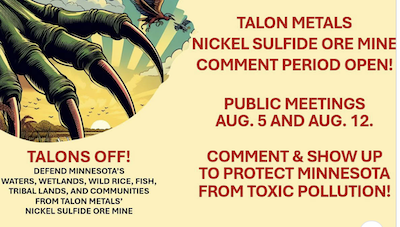
Public hearings are scheduled for August 5th in McGregor, and August 12th in Blaine.
For those who are interested in seeing and hearing what "modern mining" looks and sounds like up close ... especially as we approach public comment meetings on the Talon Mine in Aitkin County. Check out this video, which takes you to the Eagle Mine in Michigan, and to other Rio Tinto projects in Arizona, Utah, and here in northern Minnesota.
Advocates for International mining giant Rio Tinto - Kennecott share their thoughts about mining in Minnesota and around the world in this short video created using publicly available audio, and visuals gathered by Wildflower Group media collective
Shanai Matteson reports on the August 12 comment session in McGregor
My recap from last night's second (and final) DNR Public Comment Meeting about the proposed Rio Tinto - Talon Mine. Grateful to everyone who showed up or who is submitting comments!
You have until September 14th to submit a written comment:
CRITICAL VOICES STILL OUTNUMBERED THOSE IN FAVOR OF THIS MINE. THE MAJORITY OF SUPPORTERS OF THE PROJECT WERE PEOPLE WHO WILL BENEFIT FINANCIALLY, POLITICALLY, OR BOTH.
Just like last week, the gold bandanas that mine opponents wore made it clear what the majority of the crowd was there to say.
And like last week in McGregor, the critical and opposing voices were diverse, including numerous Anishinaabe and Dakota people, those who live or have cabins near the proposed mine, experts with a variety of perspectives, and those from downstream communities on the Mississippi and St. Croix.
I did not hear a single voice of support for this mine that wasn’t either a GOP politician, a union representative from an industry with contracts on the line, or someone working for a mining company or lobbying group.
Even the geologist that got up to speak in support of “Talon’s world class nickel find” works for a mining company that’s trying to build a manganese mine here in Emily, MN.
The Talon Mine is the perfect example of “The many vs. the money” – and I hope the MN DNR will take that into consideration as they weigh the feedback they received.
* * *
MINNESOTA ARTISTS ARE SHOWING UP FOR THE WATER, AND IT MATTERS, BECAUSE WE LIVE INSIDE STORIES.
Most people in the crowd were probably unaware that last night the voices of artists and writers were just as numerous as the voices of politicians.
Acclaimed Dakota author Diane Wilson spoke about her connection to the bogs and wetlands of our region, and how precious these are to us all; Anishinaabe artist and elder Sharon Day spoke powerfully for Nibi and Aki, and Dakota poet Rosie Peters, who is also a business owner in a downstream community, shared a message of love and protection.
There were also numerous artists in the room who didn’t make it to the microphone, but who I know are fierce advocates for water protection and community survival.
We live inside stories – about who we are, about what matters most, and about what is possible when we remember these things – not only in our words, but in our actions too.
We are fortunate to have these warriors of the heart in our midst, helping us to make sense of this time we are living in.
As John Trudell said, "When one lives in a society where people can no longer rely on the institutions to tell them the truth, the truth must come from culture and art."
I had my sculpture in the parking lot, and had so many conversations with attendees, including a couple of young women who work for a big company that has harmed our waters.
They told me afterwards that the images on the viewfinders made them cry. When their names were drawn, they yielded time on the mic to Native community members to speak for the water.
I hope we can keep using our creativity to deepen our relationships and solidarity!
* * *
RETIRED MINERS AND MINING ENGINEERS ALSO SHOWED UP!
We heard from Bob, who worked in taconite mines across the Range and lives on Kawishiwi River near the BWCA, which is under threat from Twin Metals. He shared economic data that confirms mining actually contributes very little to Minnesota’s economy,
especially when you factor in the losses from a degraded environment, and the clean-up costs that taxpayers end up paying when companies fold or move on,
which they always do in a boom-and-bust system.
Mike, another retired miner from Hibbing talked again about the leaking tailings pits up north, and the fact that our state agencies are already failing to enforce pollution limits on existing mines,
so how the hell can we trust them with a new one?
* * *
THE ST. CROIX VALLEY REPRESENTED! DOWNSTREAM COMMUNITIES ARE BEGINNING TO SEE THAT THIS IS AN ISSUE THAT ALSO IMPACTS THEIR LIVES & LIVELIHOODS
Numerous speakers, including Indigenous voices, local elected officials, small business owners, and conservation groups from Kettle and St. Croix River Valley spoke to the need for a regional study of impacts sulfide mining would have on this downstream watershed.
The Twin Cities-based Environmental Justice Committee gave a powerful statement in solidarity with Native and frontline communities, and all those downstream of this project.
I also noticed there were leaders from several larger clean water and green groups there in support, and who helped to turn people out to the hearing. I know Friends of the BWCA and Friends of the Mississippi both had statements prepared but didn’t make it to the mic.
* * *
RECYCLING E-WASTE IS A 'NO BUILD' ALTERNATIVE
One of the new themes that emerged from several commenters was the idea that if we truly need these metals to come from Minnesota, and if we want to create long-term jobs and grow our regional economies,
we should be investing in e-waste recycling, not new and dangerous mining.
Right now we ship most of our electronic waste overseas. Recovering more of our waste and remanufacturing electronics here in our region would net greater economic benefits for Minnesota, would create more affordable tech, and would create more sustainable jobs.
The DNR should consider this “no build” alternative when weighing the risks and benefits of copper-nickel mining here.
* * *
IT'S THE CHEMISTRY, STUPID! (AND IT'S RIO TINTO)
A number of commenters with backgrounds in chemistry and water resource science pointed out how the geology of the nickel-sulfide ore that Talon is proposing to mine here is extremely reactive with water and air.
This is not speculation, it’s scientific fact.
All mines pollute, but the ones where the nickel and copper are encased in pyrrhotite are especially dangerous.
Talon claims they will be shipping all of their ore to North Dakota or Michigan for processing, and containing their entire operation inside a “mine in a box” – but commenters pointed out that in dust form, this kind of ore is very mobile, and explosive. Their “mine in a box” concept has not been studied at all, and when it is, they will inevitably conclude that it’s too dangerous.
Reactive mine dust also causes health concerns for workers.
The pictures here are from a tour I took to Eagle Mine a couple of years ago -- another Rio Tinto project that did a "bait and switch" in permitting, starting small -- and now expanding.
American flags saturated with mine dust were hanging on the wall – and the emergency eye wash station had about a ¼ inch of metallic dust coating it. We had to wear gloves, but many workers weren’t even wearing masks.
Trucks carrying ore around the campus were uncovered, and neighbors complained of noise and emissions from unfiltered ventilation stacks. You can see some of these photos and videos on the Talon Mine Tours page.
* * *
THE STORIES MINE PROPONENTS ARE TELLING ABOUT "THE WORKING CLASS" RANG HOLLOW, AND DESPERATE.
Throughout the night, we were subjected to political elites from the Iron Range GOP talking down to the crowd like they alone represent the working class of our region.
Julie Lucas from Mining Minnesota, a group that works with multinational corporations to promote copper-nickel mining that would turn our rural and Native communities into sacrifice zones, even told a Cinderella story ...
About a “hypothetical” single mom in rural Aitkin County, a woman who “couldn’t be there” at the meeting, because she’s too poor.
She asked us to imagine this woman sitting at her kitchen table, worrying about how she’s going to afford food, housing, and car repairs.
This woman is real.
This woman is me, and so many others who live in rural Aitkin County and have for generations.
We've already had big companies come to town with promises of jobs and prosperity.
Several commenters last night mentioned the failures of the MN DNR when it came to Line 3 and their scope and permit,
But Enbridge also broke economic promises.
They said there would be "jobs jobs jobs" and businesses would boom, but the workers were almost all from out of the region, and now many of the businesses they said would boom have shuttered.
But in her version of this Cinderella story, Rio Tinto swoops in with a job, and like magic – poverty is eliminated!
* * *
WE KNOW THIS IS BULLSHIT
Our communities won't be prosperous if multinational mining companies are in control of our future.
We do need and deserve an economy that works better for more people, but a strong economy is diverse, and a mine like this threatens the diversity that makes our region so special.
This is the same story big companies have been telling our communities for over 100 years, and look where it’s gotten us.
Women and children can’t eat the fish we catch here, because mercury is a neurotoxin that already shows up in dangerous levels in the blood of 1 in 10 babies born downstream of existing mines.
There’s no housing, and few opportunities to grow businesses.
* * *
OUR LEADERS HAVE ABANDONED OUR COMMUNITIES TO SERVE CORPORATE DONORS AND POLITICAL POWER PLAYERS.
This might shock some of you, but our DFL politicians do it too.
Our political leaders are so loyal to corporations like Rio Tinto that they would poison our wells if it meant they got a campaign donation or endorsement.
People like Spencer Igo and Kari Heintzman, and company promoters like Julie Lucas, don’t represent the working class or our rural communities. They are paid marketing reps.
When the midterm elections arrive, let’s remember that?
Shanai Matteson reports on the August 5 comment session in McGregor
Some things I noticed from last night's public comment meeting on the Rio Tinto - Talon Metals nickel mine here in Aitkin County:
1) THE VOICES OF CONCERN & OPPOSITION TO THIS MINE ARE DIVERSE:
Led by Mille Lacs Band of Ojibwe and Sandy Lake Band of Mississippi Chippewa, whose reservations will be directly impacted by this mine, but also including Anishinaabeg from across the treaty territory, Anishinaabe people showed up to remind us they retain inherent rights to hunt, fish and gather here, and that means protecting lakes, rivers, and wetlands from destructive companies.
Long-term local residents showed up too — encouraged in part by grassroots organizing that's been happening in our region in spaces like Good Trouble Club | Aitkin County, Blue Brigade, BLA Indivisible & Itasca Area Indivisible — and other grassroots groups protecting their places from mine pollution, like Tamarack Water Alliance and Emily Mine Information Group.
We know rural communities like Aitkin County need economic investment, but not from a global extraction company that will risk our community health for their profit, and will benefit very few of our families.
Cabin owners and those who have been visiting our region for generations to hunt or fish or gather wild rice, or just to enjoy time at our beautiful lakes, had important messages too!
And scientists, clean water advocates, and even a few former mine engineers brought technical information about this proposal and all that it is risking.
One of the most powerful comments was from a retired taconite miner who spoke about how we already have a ticking time bomb in the leaching tailings pits up on the Range.
2) THE VOICES CHEERING FOR THIS MINE WERE NOT LOCAL, AND THEY WERE OUTNUMBERED ALMOST 3:1
Almost all (all but 1 or 2?) of the people who spoke in favor of Talon's proposed mine were people who will directly benefit, politically or economically, from this project.
Mining company spokespeople yielded their time to politicians, mostly Republicans from the Iron Range; Or to Union Reps and those from pro-industry groups like Better In Our Back Yard and Mining Minnesota, whose only argument for this project seemed to be that it might create some jobs.
3) CLEAN WATER GROUPS FROM DOWNSTREAM, THE SAVE THE BOUNDARY WATERS CROWD, AND STATEWIDE POLICY GROUPS .... WERE MOSTLY ABSENT.
I hope they will show up in Blaine next week to support our Native and rural communities, who are under-resourced and already overburdened. We need support, and that means showing up and amplifying concerns about this massive project.
WaterLegacy did some heavy lifting — but they've been working with our communities to understand this project and our rights to resist it, for many years.
We know that Aitkin County and this mine are being scoped as a sacrifice for protecting the BWCA in what Democrats always assume is unfriendly terrain.
And we know that for the most part, our concerns here are downplayed in statewide political spaces.
The only way to change this is to show up and work together. There are lots of ways to do that. If I get time today or tomorrow, I will try to lift some of those ideas up.
But please — if you can — turn up in Blaine next Wednesday and make a comment on this proposed mining project — it impacts your watersheds too!
4) ECHOS OF THE 8TH CONGRESSIONAL DISTRICT RACE ...
One of the most talked about issues in our 8th District Congressional Race has been the debate about copper-nickel mining ... Few of the candidates running attended.
John Munter for Congress spoke up for the water and protecting our environment,
and Anthony Hamilton for Congress made a powerful statement against corporations that are deceiving us about the risks and benefits of projects like this. He posted his whole statement on his page.
He's running in the primary against Pete Stauber, who I imagine was busy recovering from his terrible debate loss at Farm Fest.
Trina for Congress had a town hall meeting last night - I heard one of my submitted questions made it into the forum!
And we already know how Luke Gulbranson for Congress feels about this mine: He's for it, because jobs.
5) WHEN WE ORGANIZE TOGETHER, WE ARE POWERFUL.
I was really exhausted and nervous all day yesterday - wondering if anyone would show up, hoping it would not be the same old shit show, but people did show up, and it was inspiring.
I was listening for the values that we hold in common, and there were many.
We love this place.
We know that the treaties matter; and we have to do better when it comes to honoring and standing with our Ojibwe and Dakota neighbors.
We don't want big corporations to pollute and extract, and we know that is what will happen - because that is what is already happening,
We want these corporations out of our politics, and we want our State Agencies to work on behalf of Minnesota residents, and to stop downplaying and dismissing our concerns.
Shanai Matteson reports on a town hall meeting in Emily, MN
Tuesday night I attended a town hall meeting in Emily, MN, a very small town about 20 miles from my home near Palisade.
The meeting was about the development of a manganese mine that doesn't just threaten the town's water sources and lakeside environment,
the mineral deposit they want to mine is in the very middle of what everyone around here considers "the heart" of the community.
Mineral leases are complicated.
Most people don't realize that the person who "owns" land on the surface doesn't necessarily "own" the minerals beneath that land.
(And this is treaty land, so there is much more to consider in this topic than I can include here).
Sometimes those minerals are controlled by, and will financially benefit the property owner ... but in a lot of cases, these are controlled by and benefit (in theory?) the State of Minnesota.
(I say "in theory" because one could really debate the different benefits and burdens for Minnesota residents when we are permitting projects that pollute in perpetuity)
The point is that some of the mineral leases in Emily are controlled by the Minnesota DNR, but not all of them.
There are residents in Emily that control mineral leases the mining companies really want to exploit, and these residents aren't rushing to sell out.
The auditorium was packed with people who seemed skeptical, but they were listening.
What I heard in the Q&A section of this Town Hall — which was BY FAR the most important part, and what most were there to engage with or witness —
is that people in the town of Emily don't trust this mining company, Electric Metals (USA) and NorthStar Manganese.
They are also losing trust in the Minnesota DNR and other state regulators.
This Town Hall did not seem to help.
People were there to ask questions and to share their concerns, but before we were invited to speak at an open microphone, we were given an hour of presentations by people who the mining company had invited to cover important topics, but which instead seemed to all be versions of a marketing pitch.
They had a geologist giving a Geology of the Emily Manganese Deposit 101 type presentation .... He works for a contractor that is being paid by the mining company to explore how valuable this deposit is.
They had a scientist talking about groundwater testing and the potential risks of drilling here. She works for Barr Engineering, a consultant for the mining company and other government and business clients.
They had the Executive Director of Mining Minnesota — a group that promotes sulfide mining — talking about Mining and the Environment.
And they had Joe Henderson from the MN DNR Mines & Minerals department talking about the process of regulating mines and mineral exploitation in Minnesota.
He referenced the Rio Tinto - Kennecott - Talon Metals proposal in Tamarack a few times, showing a picture of one of their new drills,
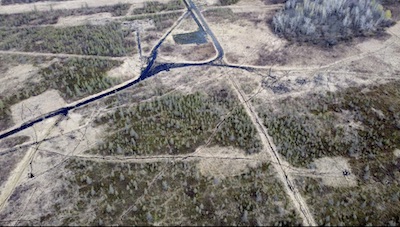
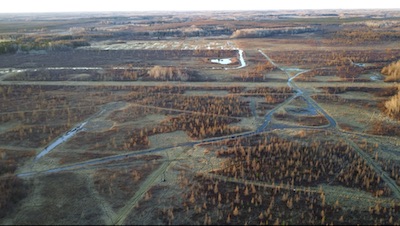
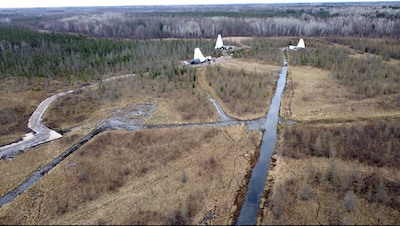
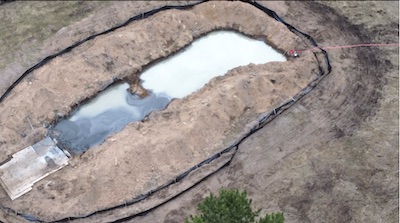
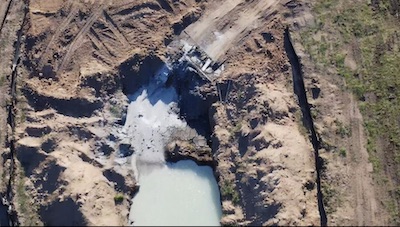
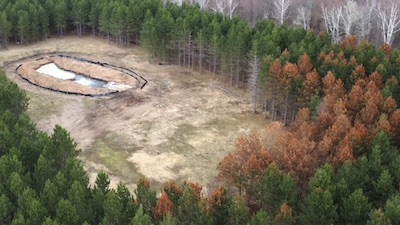
He did not show any pictures (like those attached here) of the drilling fluid sumps and damages to wetlands that Talon and Rio Tinto-Kennecott have been creating in Tamarack over the past 20 years...
Especially in the last five years, when they were operating 5 drills here 24/7 — making miles and miles of underground borings into aquifers and bedrock,
and leaving many of those borings unsealed.
It's not insignificant that Talon Metals was brought up several times on Tuesday night, they are just beginning the scoping and environmental impact assessment of that proposed mine,
and public comment is open right now.
Several presenters even referenced Talon's plans to move their processing to North Dakota, or Michigan.
They referenced Eagle Mine (also in Michigan, also now owned by Talon Metals) to assuage concerns that were raised about how a mining project could transform the environment of this little town,
and concerns that groundwater, lakes and rivers, and wild rice are at risk.
Our frontline rural communities are being sold a story about who we are, and who we can trust,
by people who have financial interest in being given permission by our state government to disturb and pollute our home places.
It's happening in mining communities, and in those facing data centers, CAFOs, pipelines ....
We are invited to these public meetings, where we're subjected to marketing pitches before we're given a couple of minutes to summarize our concerns,
and where those concerns and questions are often downplayed or dismissed.
When people in our communities object,
especially Native people,
they are treated as if they're misinformed, "just against progress," or worse — as a threat to public safety because they might protest —
and many of those same characterizations get leveled at environmental & community activists, when we are also just people who live here and don't wanna see our kids and grandkids environment degraded for short-term gains,
or for profits that never stay in our communities.
But the real threat is that corporations want something that doesn't really belong to them, and we are in the way.
They didn't put those minerals there, they just have the financial backing (maybe) and the expertise (maybe) to take them —
if they are permitted to do so —
selling them to Tesla, or to overseas markets, knowing that it's our families and children who will bear the risks,
and even those risks are unevenly distributed.
Native families and kids who depend on wild rice, fish, other foods and plant medicines that come from these treaty lands, were barely discussed by the panel in Emily.
(Julie Lucas from Mining Minnesota did refer to "the people who these lands once belonged to" so there's that.)
The mining company was emphatic that they were going to consider wild rice, and invite tribal engagement,
but there was no mention that this is actually the legal responsibility of our government,
not just something to work into a marketing pitch.
Several times, the folks from Electric Metals USA mentioned,
"we won't be processing ore, or storing mining waste, here in Emily."
This is the same claim that Talon Metals (Rio Tinto) made a couple of years ago — saying to their investors: "We listened to the community, and this is what they told us they wanted."
Now, they are pitching a "mine in a box" — a teeny tiny thing, that they claim can be done without much impact at all!
[ While also saying to their partners and investors — including Tesla, and the US Department of Defense — "This will be a 'mining district'"]
By claiming at that early stage — when there was no feasibility study of how it could even be accomplished — that they would not process or store waste here,
they were able to avoid the scrutiny of our MN Department of Health on the impacts their sulfide mine and its waste would have on groundwater, and potentially drinking water wells
as well as the issue of methylmercury in fish and those impacts on public health
Talon also received over $135 million dollars in Federal Government funding based on this claim.
At the town hall meeting in Emily, Brian Savage from Electric Metals answered a question from a skeptical resident, who pointed out that they are not in fact a mining company, they've never mined anything, they are developers and marketers ...
"We plan to get that government money from the Department of Defense [like Talon did]"
Why is the federal government subsidizing companies that are putting our communities at great risk,
and at the same time, firing the scientists and other regulators that are supposed to help determine if these projects can even meet legal standards?
Why is the DNR helping to market companies that are putting our natural resources and public health at risk,
when they are the same agency that is tasked with protecting our natural resources by evaluating and permitting those same companies to destroy wetlands and to pollute our groundwater, lakes, and rivers?
Already, studies show that 1 in 10 babies born in the Lake Superior region (where there has been mining for taconite, and a lot of mining waste dumped into our waterways ... and where existing standards are not being enforced)
1 in 10 babies (!) are born with unsafe levels of mercury in their blood.
Read that again.
Mercury at this level is a neurotoxin that measurably affects intelligence.
They are poisoning our children,
to make a profit.
At this town hall meeting, people of Emily were not having it.
When it was Q & A time, their questions were well informed, and all of those who spoke at the microphone expressed frustration and distrust.
There is something these mining companies don't want you to know:
You can talk to people in other communities who've dealt with these companies and these processes.
We can visit with people in Michigan, Wisconsin, other places in Minnesota, or across the country.
There's a playbook to how these companies operate to try to get what some call "a social license."
When regulators, companies, lobbyists, elected officials, and the science and engineering contractors that work between them,
are all hanging out, telling the same stories,
you know you need to be especially diligent about paying attention.
A question to ask all our electeds and candidates, as well as voters:
"What kind of regulatory envrironment are we going to permit? Is it really this one? The one that seems to be controlled by multinational bad actors and their partners in our state and county government?"
It's time to get serious about defending our lands and waters,
defending sovereignty for Native nations and people, who are the frontlines and the fiercest fighters for our mother earth,
and also, defending the self-determination of local communities whose livelihoods and health are also at stake.
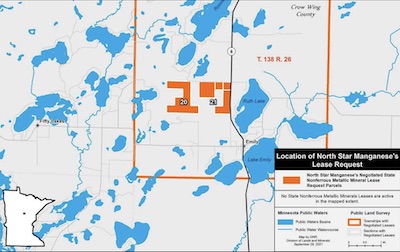
Location of North Star Manganese Leese Request
An image of the wetlands near Talon Metals headquarters in Tamarack taken this past Spring — you can see all the paths they've been making here as they move their drills around.
One of Talon Metals unlined drilling fluid sumps — taken this past spring by a community member near their headquarters in Tamarack
If you've seen other pictures of this area, you might remember that there were trees dying around the old sump that they buried without testing ... They claimed it was because "the roots of the trees were covered" - and cut down those trees - but here they are a few years later, still dying....
The worst sulfide minerals and public comments on Talon's mine proposal
"We're back! And we're talking about an important open public comments period for the MN DNR's environmental review of Talon Minerals' mine proposal in Tamarack Minnesota. "
Good evening, neighbors and members of the panel. My name is Hallie Pond & I live in Cass County.
As a child growing up in the northland, I frolicked through the pines and spent many summer days fishing the lakes across our region. I remember feeling the unbridled joy as a child coming home with the catch of the day, gathering with family and friends, and sharing a fish fry from our local bounty. The lakes and forests haven't just fed us; they’ve shaped who we are and our way of life.
Now, these sacred waters, forests, and our bodies are at risk.
Talon Metals and Rio Tinto are proposing a sulfide nickel mine in sensitive peatlands—a process scientifically recognized as the most toxic form of extraction on Earth. Sulfide runoff into these wetlands accelerates bacteria that convert dormant mercury into lethal methylmercury, threatening a six-fold spike in local streams. This potent neurotoxin bioaccumulates, crippling the central nervous systems of our wildlife and causing brain damage, memory loss, and cognitive impairment in our children and families.
With Talon and Rio Tinto’s proven history of repeatedly cutting corners related to environmental safeguards and their failure to clean up the messes they make, this project will poison our water, fish, wild rice, and our bodies. Our public health and ecosystems are being treated as collateral damage to line the pockets of billionaires while socializing permanent toxic costs onto rural, economically disadvantaged families. We refuse to sacrifice this land and our well-being for corporate profit.
Before a single permit is considered, a rigorous Environmental Impact Statement (EIS) scoping process must be replete and fully transparent. Please require complete baseline data on current mercury, methylmercury, sulfate, and sulfide levels across local wetlands, lakes, and streams, alongside a full analysis of existing hydrology and how climate-driven droughts and extreme floods will impact wetland dewatering and rewetting. Furthermore, the EIS should fully calculate air emissions of mercury and sulfide from ore crushing and fuel combustion, establish strict accounting for all contact, storm, and treated water releases, and disclose every precise discharge location and volume.
True social and economic freedom will never come from corporate dependency or environmental sacrifice; it must be built through sustained investment in our local communities. We can achieve this by transitioning toward a restoration and infrastructure economy that leverages federal and state funding for watershed restoration, climate-resilient forestry, and clean infrastructure jobs that remain in Minnesota.
Simultaneously, we must protect the lakes, forests, and wild rice waters that already sustain our multi-million-dollar local tourism, outdoor recreation, and regional food economies.
True progress requires driving closed-loop battery innovation through targeted investments in battery recycling and alternative chemistries—eliminating the need for destructive sulfide extraction altogether while securing a resilient, sustainable future for Minnesota.
These waters, these pines, and our health are not disposable trade-offs for foreign profit, and we refuse to let corporate interests gloss over the true, permanent cost to Minnesota water, land, and our health.
Say NO to the Talon Tamarack project. Thank you.
We Have Seen This Playbook Before
Shanai Matteson: 2026-08-05 public meeting (3-minute spoken comment)
My name is Shanai Matteson. I grew-up in this community, and I live downstream of the proposed mine in Aitkin County, right on the banks of the Mississippi River.
The Minnesota DNR is enabling harm to treaty lands and waters, and to our Native and rural communities.
We have seen this playbook before —
most recently, when Enbridge Energy built the Line 3 oil pipeline just a few miles from this proposed sulfide mine.
The scoping and EIS for Line 3 was deeply flawed.
This was exposed by scientists, tribal people, and the majority of Minnesotans who made public comments. Enbridge failed to study groundwater impacts in what is a very wet region.
And now, the DNR is helping Talon Metals avoid responsibility for dumping drilling wastes in unlined sumps, potentially contaminating groundwater again.
Our Minnesota Department of Health is allowing them to expose us to groundwater contamination, by rubber stamping exemptions to Minnesota's well code - allowing them to leave hundreds of exploratory drill holes unsealed.
When I requested reports about Rio Tinto and Talon’s drilling program, the employee that MN DNR had gather this data for me was hired directly from Rio Tinto and Talon Metals. Her family received $2 million dollars for their land - land in a poor community where Rio Tinto and Talon are now trying to permit Minnesota's first sulfide ore mine.
Now, DNR Lands & Minerals Department is going out to our communities selling us a "limited scope" mining project while allowing Talon to mislead us about the size of their intended mine and ignoring Rio Tinto’s dirty and deceptive track record.
Talon gives us unstudied claims about shipping ore and pollution to North Dakota. Talon says shipping pollution to another state is what our community wanted. But we don’t want this concept to be a loophole in the EIS.
We want to see Talon’s real plans.
It’s insulting to the people of this community to give us 3 minutes to talk, when mine impacts will last for centuries.
Don’t ignore the entire deposit that Rio Tinto and Talon control.
Tell the truth about groundwater modeling, require a Health Impact Assessment, and don’t take us for fools.
Public Comment to Minnesota Dept of Natural Resources Regarding the Proposed Tamarack Mine Project
Written comment by Jesse Bearheart
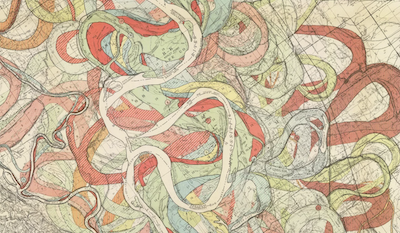
The map above was created by Howard Fisk, a professor at Louisiana State University in 1944.
Fisk was a geologist and cartographer who worked with the U.S.Army Corps of Engineers, who, over the course of fifteen years, chronicled the Mississippi River's course from the Pleistocene Period to his day. His publication, Geological Investigation of the Alluvial Valley of the Lower Mississippi River, Fisk highlighted the results in changes based on core sampling of soils and subsoils. He noticed major changes in the Earth's chemistry and composition after the introduction of steamboats, and later, barge traffic along the Mississippi attributed to greater churn of its waters. Fisk found in his studies that the Mississippi changes course about every 1000 years.
The Mississippi River is a primary body of water with the largest drainage basin in the United States. It was a highway system for First Nations People for thousands of years, supplies communities with drinking water to many communities, and continues to be a conduit of commerce. Roughly seven million people live along its banks, 16,000 of whom live in Aitken County and are directly within its watershed. It is home to innumerable aquatic flora species, including rich wild rice stands harvested by Native and non-native people. It is home to 375 fish species, some as ancient as sturgeon, various aquatic species of reptiles, amphibians, and mollusks, and crustaceans; it also supports fifty-seven mammal species. 326 species of birds use the river basin as a flyway each year; about 60% of all migratory birds use it. Water Is Life. The average depth of the water from Lake Itasca to Minneapolis is three feet deep. The Upper Mississippi River contributes about $24.6 billion in tourism and recreational industry support.
The downside is that, through human agricultural and industrial activities, it already generates 31% of nutrients and pollutants responsible for Gulf Hypoxia further downstream. Adding pyrrhotite, sulphates and nitrates through the mining process to this mix is unconscionable! Given the topography of the land. the low water levels, the many creeks, streams, and other tributaries that flow into the Mississippi River, many too small to be named but still vital and dynamic, i ask that you seriously consider the impact of this project, follow the science, do your own research, then give us one example of this mining process that has no environmental impact.
They want the money, it's really that simple
Shanai Matteson: 2026-08-12 public meeting (3-minute spoken comment)
My name is Shanai Matteson. I live downstream of the proposed mine in Aitkin County, on the Mississippi River.
My family has been living in Aitkin County for 6 generations if you count my two kids and their cousins.
We fish, we hunt, we gather wild rice and maple sugar ... all things we’ve learned to do alongside our Anishinaabe neighbors and relatives, who remind us that the abundance of water and life here is a gift to protect for the next seven generations,
not something to exploit for short-term jobs and profits.
* * *
My grandma Spolarich, who is well into her 90s now, spent all but one year of her life living next to the Willow and Mississippi Rivers in Aitkin County – the year she lived in Keewatin,
where my grandpa, her new husband, whose family had only recently emigrated here from Croatia, worked in the iron mines.
After a year living with noise from blasts and machines and red dust coating everything, even her teeth – she demanded they move back to the swamps of Aitkin County.
(She told me once that if he'd said no, she was prepared to leave him with his mine pit!)
I think he made the right choice, and I know he loved and cared for these lands and waters.
Even though my grandpa and others in my family have always had working-class jobs, I don't think any of us would say that its the corporations who support us.
We work our asses off, and families still struggle. What supports us most of all is this place that we love — this clean water — this place where we can hear ourselves think, and where life flourishes.
Aitkin County is not the Iron Range, and thank goodness for that!
I have nothing against miners or those communities that have struggled in the booms and busts of mining – but I don’t think we want global companies like Rio Tinto to be in control of our lives and livelihoods the way they have been in other parts of our region for generations.
The proposed Tamarack project is deceptive and dangerous.
Aitkin County, including the proposed mine site, is surrounded by water and wetlands.
Globally rare peat bogs, abundant wild rice lakes, swamps that hold water and sequester carbon, the Mississippi River and numerous streams ... and so much water underground we don’t even know how it's all connected.
Rio Tinto’s name is on 31,000 acres of mineral leases.
They’ve been drilling the entire ore body and talking to their investors and partners, including Tesla and the Federal Government, about a “mining district” that would rival others around the world in size and value.
They’ve even been drilling in the south end of the deposit, near Salo Marsh and Rice Lake, an area they refer to as “the bowl,” which geologists say has not only copper and nickel, but palladium and other precious metals.
They want the money, it's really that simple.
Our federal government is no longer a reliable partner committed to protecting the environment or the rule of law. Just last week, President Trump sat with executives from Rio Tinto and other mining corporations, to talk about investing billions of dollars to “jump start” critical minerals projects on US soil that would enrich an already ravenous global elite.
I urge the DNR to take very seriously that we are being scoped as a sacrifice zone. This project is a bait and switch.
Our frontline communities deserve the truth about Rio Tinto and Talon Metals' true plans for our region.
We need a regional study of groundwater and surface water impacts of sulfide ore mining here before any talk of permitting the kind of “district scale” project they are surely scoping here.
This is 1855 Treaty Territory, and Treaties are the Supreme Law of the Lands
Leanna, Leech Lake Band of Ojibwe: 2026-08-05 public meeting (3-minute spoken comment)
I Do Not Stand Here Alone
Curtis Jackson of Miinissinaakwang / East Lake, MN: 2026-08-05 public meeting (3-minute spoken comment)